LEAVING ASSISTED LIVING
Why do the 90% do it?
What do these people LEAVE assisted living, and what can be done about it?
People talk about COMING to assisted living. Website after website tries to convince seniors to “Choose ME!” “Choose ME!” “Choose ME!”
Assisted living communities invest enormous budgets on Sales and Marketing dedicated to getting seniors to COME to their communities, yet they invest NOTHING on learning why seniors LEAVE their communities.
When was the last time you heard a discussion about why people LEAVE assisted living? After all – LEAVING is 50% of the discussion, right? Everyone who COMES to assisted living must ultimately, at some point, LEAVE. So why do we address only half of the conversation (COMING) and ignore the other half (LEAVING)?
And what are the consequences of this ‘one-eyed’ view?
By ignoring half of the conversation, we ignore half of the opportunities to stabilize occupancy.
Let’s take a deeper look into LEAVING and see if we can make any progress in our understanding about it. Knowledge and understanding is what may ultimately help us put the brakes on the revolving door into and out of assisted living.
WHY DO PEOPLE LEAVE ASSISTED LIVING?
Declining health, that’s why.
When people leave, over 90% of them are forced to do so because of declining health. The other 10% leave for a variety of other reasons, and that includes, perhaps, only about 5% who leave for hospitality reasons.
So, to make the greatest impact on leaving, do we address the 5% who leave for hospitality reasons, or the 90% who leave for health reasons? I choose the latter.
WHAT PRECIPITATES DECLINING HEALTH?
An acute health event of some kind is the harbinger of declining health and what usually precipitates leaving. And this is why residents are lost to the ER or hospital. Here are some examples we’re all familiar with:
- they fall, or
- they get a urinary tract infection, or
- they get pneumonia, or
- they get a foot infection, or
- they get weak and dizzy, or
- they get short of breath, or
- they die, or
- and on and on.
WHAT CAN WE DO ABOUT LEAVING?
How can we reduce the acute health events that cause the 90% to leave? Do we perseverate on the 5% and continue with the same well-worn “solutions?”
- A new lunch menu?
- Another activity added to the 20 other activities already available?
- A gelato machine?
- A mini bar?
- Even better hospitality?
Or should we gain a better understanding of resident health so we can manage it better?
If we choose the latter, then perhaps…just perhaps…we might discover something we could do to stabilize the health of the 90% and prevent or reduce the decline. And if we had a more targeted focus on resident health, then perhaps these acute events would be more predictable and manageable than they are currently, so that we could identify them earlier and solve them before losing the resident to the hospital.
WHAT SHOULD WE TARGET?
Chronic Diseases and their management – THAT’S the target.
Assisted living residents have a lot of chronic diseases. Our research database of 9000 assisted living residents tells us that each resident averages 7-8 different chronic diseases (many residents have more), and they each take a minimum of 6-7 different types of prescribed medications every day to support these diseases. So this is the key – chronic diseases and how they are managed – that may help us keep the 90% from leaving.
Let me illustrate how proactive management of the 90%’s chronic diseases can potentially cause fewer residents to leave.
ACUTE HEALTH EVENTS CAN TEACH US HOW TO MANAGE
CHRONIC DISEASES BETTER.
INSIGHT: Every chronic disease is associated with a set of acute health events that precipitate resident decline.
Here’s the mindset that you MUST have: it is NEVER acceptable to lose a resident to the ER or hospital. And whenever it happens, we will review our care of this resident to determine what we can improve from this point onward so that it doesn’t occur for other residents.
The Table below is an example only and is not meant to be complete. It shows how acute health events can teach us how to manage chronic diseases better. The Table shows:
- 3 of the many chronic diseases (left column) that residents can have.
- Some acute health events (middle column) associated with them.
- Some common causes of the acute health events (right column).
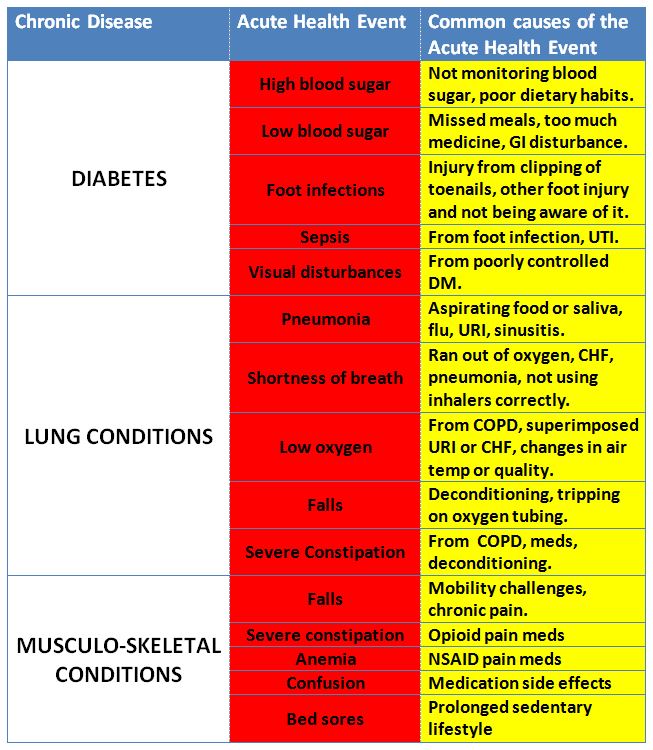
You can use a Table like this to understand how you might reduce the number of residents who leave.
For example – let’s say you lose a resident to the ER because he developed pneumonia. When you review the resident’s record, it turns out he has COPD as a chronic disease which put him at risk for this acute event. The Table tells you some of the common causes or symptoms this resident may have exhibited that led to him getting pneumonia. You then review this resident with your care staff to discover what you can implement to reduce the likelihood of other residents with COPD from coming down with pneumonia. Examples might be:
- Closer monitoring of COPD residents during meals to check for choking episodes.
- Making sure COPD residents are up to date with their pneumonia, flu, and shingles vaccinations.
- Proactively connecting COPD residents with their doctors at the first sign of a cold or sinus problem, especially during allergy seasons.
Similar Quality Improvement approaches could be considered for every single resident that is lost to the ER or hospital.
This pattern of Continuous Quality Improvement provides the best chances for reducing the number of residents leaving your community.
FINAL REMARKS
Learning about why the 90% LEAVE your community will open an entirely new dialogue that will help you provide better care to your residents. Implementing the lessons learned from this dialogue will lead to more stable resident health and therefore a more stable occupancy.
E-mail me with comments:
st**********@il*******************.com

Dr. Steven Fuller
Dr. Steven Fuller is a triple board certified physician/entrepreneur who develops programs in support of an Integrated Care model of senior housing. This model includes 3 equal, interactive, and mutually supportive team members: real estate, hospitality, and healthcare.
<< Back to Blog Home
Latest Posts