An innovative way to use dementia data
 (click image to enlarge)
The better you understand your assisted living residents, the better the care you can provide.
If you know only 1 fact about a resident (like someone you just met a second ago), then you can only guess whether anything you say or offer may be of interest or benefit to that person. But if you know many facts about a resident and have a broad understanding of him (like with a childhood friend), then you can anticipate almost with certainty how he would react to a particular situation or event.
So how can you clearly articulate this important concept of ‘understanding’ of assisted living residents, which intuitively makes a lot of sense but is still somewhat vague and intangible. How do you make ‘understanding’ a concrete and actionable tool you can use every day to help your residents? Here’s an idea that may help:
DEMENTIA PROFILE
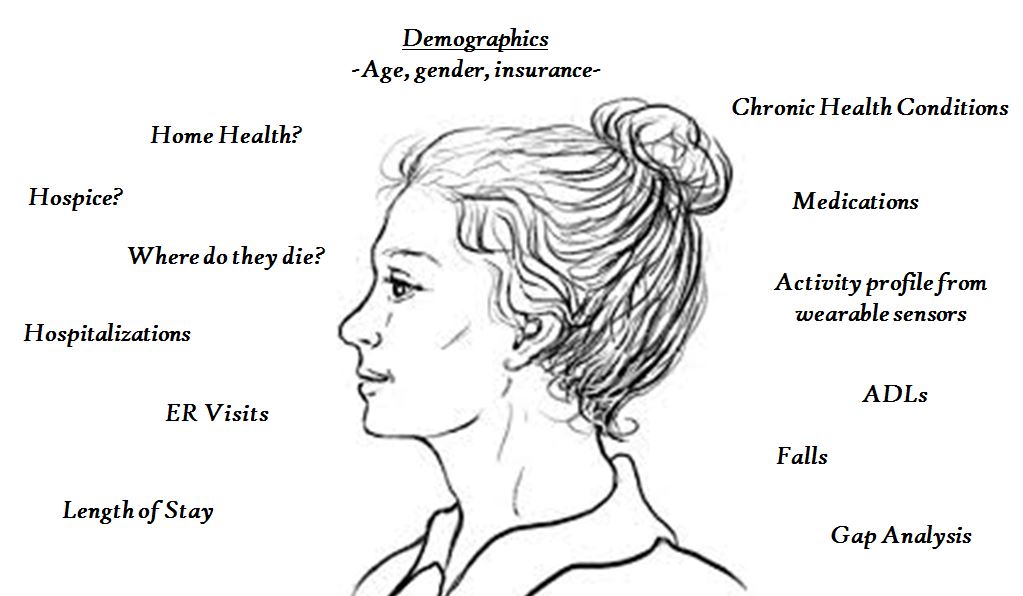
Create a Dementia Profile* – a Profile that distills important health information from a variety of sources (shown in the Figure above) and blended into a clear silhouette. Having this key health information available at your fingertips in the form of an easily accessible and understood Dementia Profile will do the following:
- Increase your understanding of dementia residents.
- Provide support for data-driven decisions about the most appropriate services that are needed.
- Shine a light on areas that need improvement.
- Predict the needs of your future dementia residents.
- Identify important areas for staff training and education.
- Allow comparison of the Dementia Profiles of different communities owned by the same corporation. This may reveal community-specific differences that would otherwise go unrecognized when data are dispersed or not captured.
- And this would yield opportunities to customize resident healthcare and provide data-driven, resident-centric care. For example – a Dementia Profile showing more ER visits or more falls in one community in comparison to its sister communities may prompt further investigation that could unveil opportunities for improvement.
- Standardize your method of collecting and organizing disease-specific data. This will allow consistency in data analyses on a corporate level and yield greater appreciation of best practices.
- Market differentiation and highlight you as a leader in innovative resident healthcare.
As an extension of this concept, you could create Profiles for each of the dominate health conditions in your community. Just as with Dementia Profiles, you can also design the following:
- Cardiac Profile
- Diabetes Profile
- Depression Profile
- Anxiety Profile
- Breathing Profile
- Parkinson’s Profile
Now you can use these profiles to predict the needs of all your prospective residents and develop customized solutions. When someone calls or tours your community, and you learn about some of the chronic health conditions that they can no longer manage, you can refer to the appropriate Profile as a marketing tool. You tell them, with specifics, about the programs and services you currently have in place precisely for that condition.
Can you imagine how comforting and reassuring this would be to those customers? Can you imagine the favorable reaction of your local referral base (doctors, hospitals, SNFs, etc.) when they see your innovative approach! And can you even imagine the favorable reaction of your state surveyors?
To implement a Dementia Profile is not a matter of data – in most cases the data are either easily available or can be easily obtained.
What’s needed is:
- Vision
- Leadership
- The courage to be bold and try something new.
Please e-mail me at
st**********@il*******************.com
to discuss your thoughts about Dementia Profiles.
*A conceptually similar approach has recently been described in the care of dementia patients in England.

Dr. Steven Fuller
Dr. Steven Fuller is a triple board certified physician/entrepreneur who develops programs in support of an Integrated Care model of senior housing. This model includes 3 equal, interactive, and mutually supportive team members: real estate, hospitality, and healthcare.
<< Back to Blog Home
Latest Posts