
Uncomfortable Questions
Dementia is a devastating disease.
Everyone knows this. And in our society, it dominates the attention of the victim, the family, caregivers, healthcare professionals, nonprofit organizations, centers of research, and so many others.
Senior housing is not immune from the impact of dementia, as it is charged with designing an environment for the safe care of these residents. Many assisted living communities have developed separate Memory Care Units with unique architectural and care designs, specially trained staff, and specialized programs and services.
When a person has dementia, for the remainder of that person’s life, the entire world revolves around the care and treatment of his dementia.
And therein lies the trap…
The temptation to view dementia out of context
From the healthcare standpoint, dementia is only one of many chronic health issues that afflict seniors. There are other health issues that are just as important.
Let me illustrate:
The following Health Profile shows 17 of the most common chronic health conditions found in assisted living (AL) residents. These conditions are shown in order of frequency, from the most frequent on the left of the profile to the least frequent on the right.
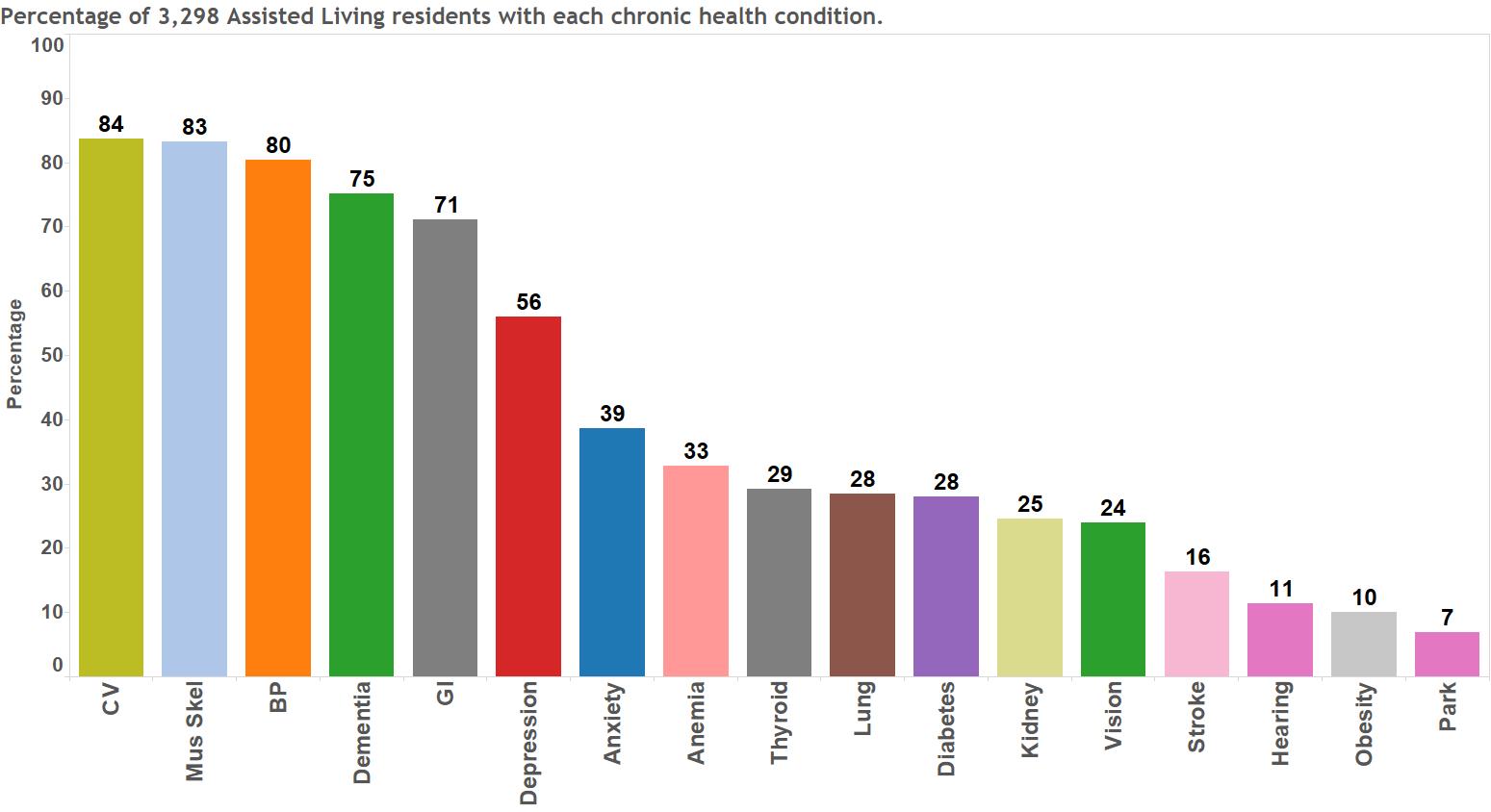 (click on Figure to enlarge)
As you can see, dementia is just one of the many distressing chronic health conditions that consume AL residents. And it’s not even the most frequent, but rather the 4th most frequent.
And what I haven’t shown is that dementia residents typically have about 8 chronic health conditions and take 6-7 different prescribed medicines, just like all the other AL residents. So from the healthcare standpoint, dementia residents aren’t so different after all. They have a similar assortment of chronic health conditions and take similar medicines. And they must all be managed with equal skill and attention.
So this raises a few interesting and even uncomfortable questions: are we, unintentionally, overemphasizing the significance of dementia in the care of AL residents? Is the disproportionate emphasis on the care and services provided to dementia residents distracting us from providing similar support that would benefit residents having other chronic health conditions?
For example: there are Memory Care Units for dementia residents. But have you seen specialized units dedicated to the aggressive care and management of other, equally important, chronic health conditions, some of which are even more frequent? If you were to search, could you locate assisted living communities advertising that they have:
- ‘Diabetes Care Units’ for residents suffering from the complications of diabetes?
- ‘Respiratory Care Units’ for residents whose lives are dominated by severe COPD and who struggle for every single breath?
- ‘Chronic Pain Units’ for residents with severe arthritis or other musculoskeletal problems who are in pain with every movement, every waking moment?
- ‘Cardiac Units,’ because residents with heart problems present the highest risk for hospital readmissions?
- ‘Depression Units,’ as this common condition ravages the quality of life of its victims and also puts them at higher risk for hospitalization and readmissions?
These specialized units are not generally available. So why is dementia singled out with special units and services not afforded to residents with other chronic health conditions?
I’m afraid I don’t have an answer here. But I think it’s important to raise this issue for discussion, and I’m very interested in readers’ opinions. Perhaps it will remind us that residents with dementia are ‘more’ than their chronic disease and have many dimensions. And from the healthcare standpoint in assisted living, we should consider whether to implement a more balanced and proportionate emphasis in the care directed at all chronic health conditions.
Please e-mail me with your comments and suggestions:
St**********@il*******************.com
.

Dr. Steven Fuller
Dr. Steven Fuller is a triple board certified physician/entrepreneur who develops programs in support of an Integrated Care model of senior housing. This model includes 3 equal, interactive, and mutually supportive team members: real estate, hospitality, and healthcare.
<< Back to Blog Home
Latest Posts