Our general discussions about assisted living residents tend to lump all residents
into 1 category. We don’t lend sufficient importance to the different health characteristics the residents have and how these differences may impact the services provided by the AL. The unintended consequence of lumping the residents into 1 category is to misunderstand the health challenges of caring for this population. In fact, AL residents are not a homogeneous population, and their differences in health conditions really do matter.
 (click to enlarge)
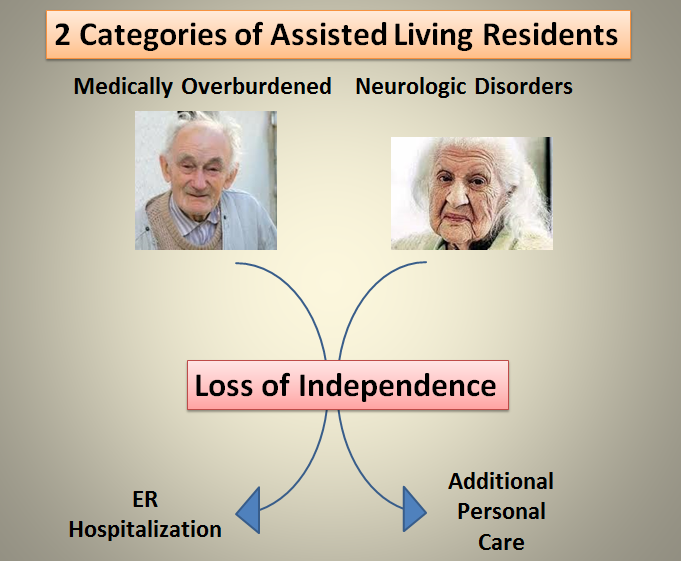
Our early discovery using health analytics highlights some valuable insights. Preliminary data from HEALTH PROFILES suggests many assisted living facilities have 2 very distinct types of residents all living under one roof, yet with very different characteristics and needs. Our results suggest that distinguishing these 2 categories may be important, because successful management hinges on very different caregiver skills and facility health services.
Here are 2 different categories that stand out:
- Neurologic Disorders
- The most common are dementia, stroke, and Parkinsons. Less common conditions include MS (multiple sclerosis), ALS (amyotrophic lateral sclerosis), and others.
- Medically Overburdened
- These are residents having a large number of health issues resulting in a high complexity of care (i.e., a high HEALTH BURDEN).
The common feature of both these groups is loss of independence, and that’s what had led them to assisted living. But the reasons causing this loss are very different between the 2 groups. And that suggests that successful health management of the 2 groups is also very different.
The following table is an overview of some distinguishing attributes: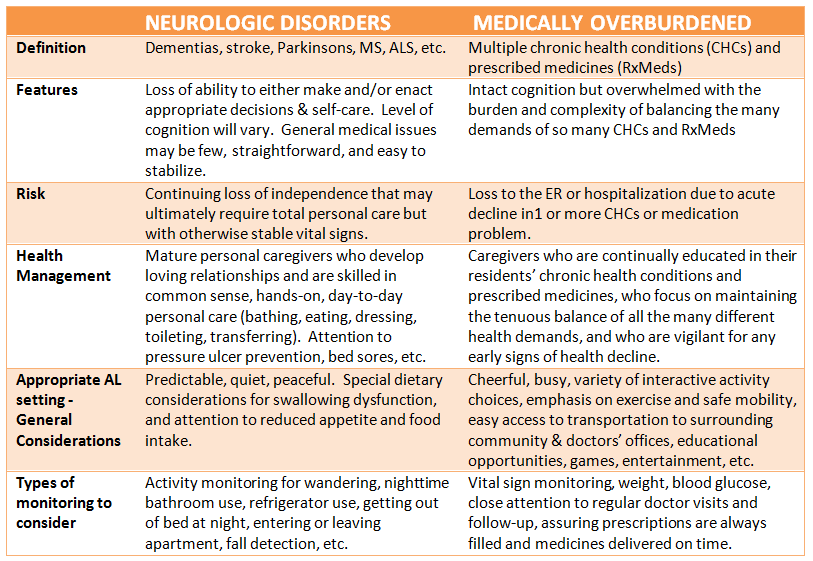 (click to enlarge)
In general, for the Medically Overburdened resident, management centers on stabilizing health and maintaining the tenuous equilibrium of a multitude of chronic health conditions and the wide variety (and potential toxicity) of all the medicines used to treat them. Caregivers must have a broad knowledge base about these health issues in order to provide competent care and identify any early signs of declining health. The primary risk is losing the resident to the ER or hospitalization. There is a greater need for close communication with residents’ doctors in order to maintain the balance of a multitude of medical needs.
For residents whose care is dominated by Neurologic Disorders, the greatest risk is continuing loss of independence and ability for self-care rather than loss to the ER or hospitalization. Residents’ abilities may range from being ambulatory with intact cognition and fully verbal all the way to a nonverbal, vegetative state requiring total personal care. Medical management is usually uncomplicated and straightforward, as the medical issues are often much less complex. Therefore, caregivers must be most proficient in hands-on personal care
These are examples of the tangible insights that health analytics can provide and promote. They help us become more aware of issues immediately before us and show us where we can enhance our management.
Focused thinking guided by analytics is beneficial to everyone.
<< Back to Blog Home
Latest Posts